
Bad Bunny’s Halftime show – Unifying America
By: Riley Duignan
On February 8, 2026, Bad Bunny performed the Super Bowl halftime show, though many NFL fans were strongly against it. Here’s a breakdown of the performance and the easter eggs inside of it.
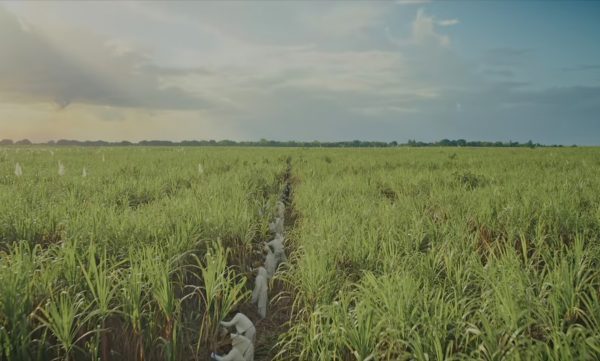
In the beginning, the audience is guided to a large sugar cane field with numerous laborers harvesting the sugar cane, directly referencing the rich soil in Puerto Rico that grows a large amount of sugar cane, a resource the U.S. has milked continuously from Puerto Rico and their laborers. According to the USDA, by 1934, the U.S. owned and controlled over 80% of the sugar cane farms in Puerto Rico. This extreme exploitation by the U.S. caused immense poverty rates, debt, and poverty incomes. As of today, the U.S. does not own much of any sugar cane fields and instead most of that soil is idle or now government property. But the economic instability of that exploitation is still seen in Puerto Rico today.
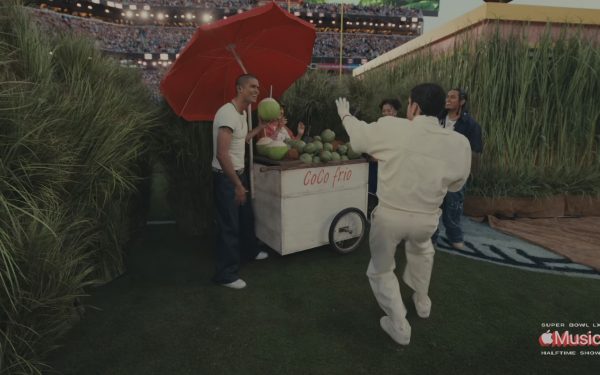
As he’s walking through the maze of sugar cane plants, a typical Puerto Rican neighborhood begins to be illustrated. Bad Bunny first walks past a Coco Frio drink stand, a popular drink in Puerto Rico and other Caribbean countries. Next, he walks past a group of old men drinking at a table and playing dominoes, representing frequent community and social gatherings among Latin communities and the typical socialization seen in Puerto Rican/Latin neighborhoods. Walking away from them, he walks past a nail salon, with a woman getting her nails done, a representation of Latin and Hispanic culture and workforces that often aren’t represented or spoken about, a pink-collar job.
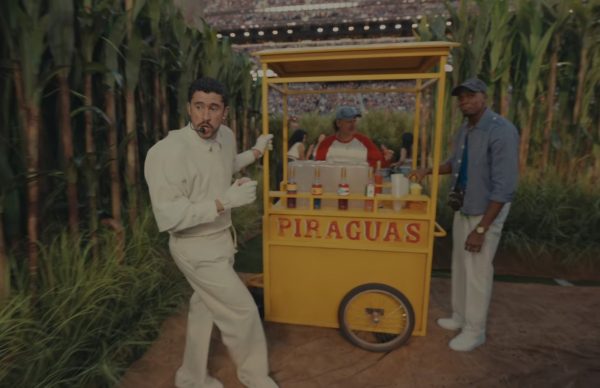
Bad bunny again walks past another group of people, this being female workers at a construction site. This is likely to be a direct reference to the rebuilding of Puerto Rico following the destruction of Hurricane Maria. Hurricane Maria was devastating to Puerto Rico, as it caused losses of around $90 billion, and 3059 deaths, 2975 of them being from Puerto Rico alone. It damaged already weak infrastructure and caused more weakened power lines, an already frequent problem in Puerto Rico. But many believe it holds two meanings, with the other interpretation being that women are the concrete strength of Puerto Rican houses and families, they are what keep them together and are the strength of the home, just as the majority of the houses in Puerto Rico are made of concrete, majority of houses are built and stabilized by the mothers, daughters, aunts, grandmothers, etc. of the family. Possibly celebrating women as a whole and their importance to stability and love in Puerto Rican homes. After that, he walks past a stand labeled “Piraguas” a very popular Puerto Rican dessert of shaved ice and other flavorings, usually fruity and tropical. Most Americans in the northern Americas (U.S, Canada) are familiar with this dessert, as its very similar to shaved ice, with shredded ice and flavored syrups. Each flavor bottle at this Piraguas stand has a different latin flag on it, including Columbia, Spain, Puerto Rico, and Mexico, countries where this dessert is also very popular and showing the commonality between numerous Latin countries.
Bad Bunny then walks up to the Villas Tacos stand, an actual locally owned restaurant in Los Angeles, handing over the Piragua to the cook of the Villas Tacos. This is collectively being interpreted as an exchange and unity of different Latin cultures through the exchange of food. Walking away, he ducks under two boxers: Emiliano Vargas, a Mexican-American boxer, and Xander Zayas, a famous Puerto Rican boxer. Emphasizing the importance of boxing to Puerto Rico and Hispanic/Latin countries as a whole.
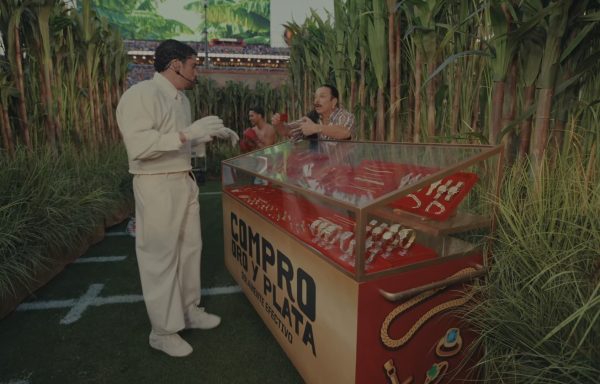
Bad Bunny walks up to a seller at a booth called “Compro oro y plata”, which in English translates to “I buy silver and gold”, a reference to the hustle and prevalence of local jewelry businesses in Puerto Rico and Caribbean countries. With Latin and Hispanic audiences online stating you see these shops and booths everywhere in Hispanic/Latin countries, it’s a frequent business and easily gets money from tourists as well.
He then goes to la casita, a house that is used in Bad bunnies albums and a representation of Puerto rican houses, homey, but vibrant and lively. It is not huge, but its a commonly seen house style and size among Puerto Ricans. Numerous influencers and celebrities like Pedro Pascal, Cardi B, Young Miko, Karol G, and others danced on the porch of La Casita, of all ethnicities, including Hispanic, black, and white. Representing that everybody is welcome in la casita, or in better words, to celebrate Hispanic culture with each other. This is where the representation of party and dancing culture in Hispanic groups are shown, as celebrities dance on the porch, and a group of women dances their choreography in front of La Casita.
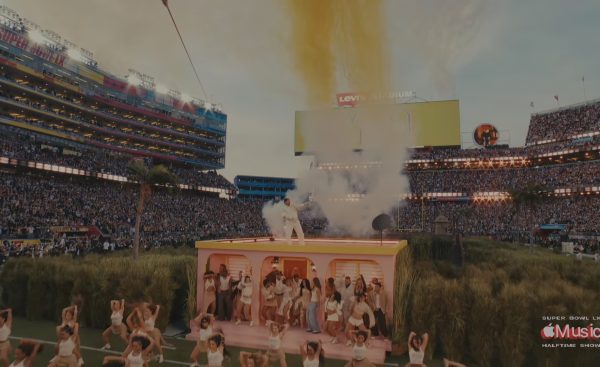
As Bad Bunny is standing on the roof of La Casita, he falls through, possibly referring to the weakening infrastructure of Puerto Rican houses, and the fact that many don’t have the money to strengthen their houses’ infrastructure. Inside the house he falls into, people have pointed out the very common Latino staple household items, including a cross, a statue of virgin mary, colorful curtains and furniture, and decorative plates and utensils being displayed. Walking out of la casita, he joins the energetic crowd, quickly playing snippets of iconic Hispanic music, including “Dale Don Dale” By Don Omar, “Noche de Travesura” by Hector el father, and “Gasolina” by Daddy Yankee. Known by most people throughout the Americas, he played songs that helped build Latin and Hispanic representation in music.
He climbs on top of a ford pick up truck, with many people pointing out that this is a common truck for Hispanic immigrants in the U.S., as it was most accessible and affordable, especially for construction workers, a workforce and job that is often under-represented but a common, well-paying job that many immigrants work for, especially undocumented. This is likely a tribute and call out to the Hispanic people who have worked so diligently for a better life and are the building blocks of the United States.
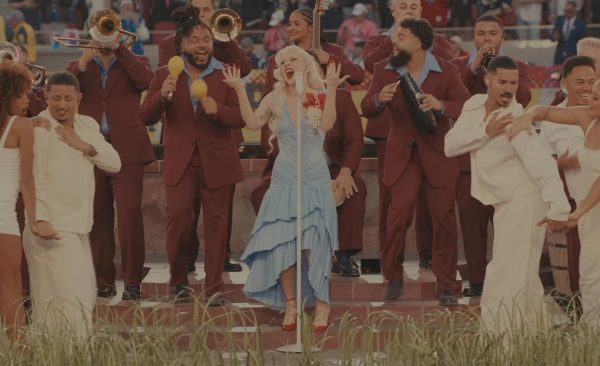
A few minutes later, we’re led to an elevated stage, with Lady Gaga appearing and performing a Latin-inspired version of her song, “Die With a Smile” with Bruno Mars. The band playing behind her is “Los Sobrinos”, a familiar Puerto Rican band that collaborated with Bad Bunny in his DTmF era. Lady Gaga is wearing a light blue dress, likely symbolizing the light blue on the Puerto Rican flag of independence made in 1895, banned by the U.S, and then legalized again in 1957, but making the Puerto Rican flag the same colors as the United States flag. This symbolizes the push for independence and sovereignty of Puerto Rico, as the US forced assimilation and erasure of the current independence of Puerto Rican land and culture. In the dance break, Lady Gaga and Bad Bunny begin to salsa, a common Latin American dance. From there the camera guides us away from Lady Gaga and instead to the rush and chaos of a wedding party. Bad bunny walks over and nudges a kid taking a nap on the party chair to wake up, many relating and seeing this as a representation and commonality of Hispanic culture, as parties are common, and many children when bored or exhausted find something to lay on to sleep, usually chairs. Many online audiences say how closely they relate to this small experience when they were a kid.
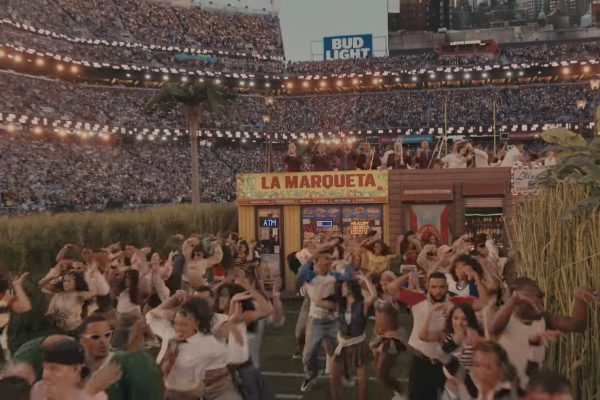
After this, Bad Bunny walks into a crowd within a neighborhood with stores including a market and a barber shop. This is where the population “Nuyoricans” are introduced. Nuyoricans, a combination of “New Yorker” and “Puerto Ricans”, are people with Puerto Rican heritage that are born and raised in New York City. They blend Puerto Rican culture with American culture, creating a lively and culturally rich community. The community began to form after large migration waves after world war 2, and has been a significant community in Brooklyn and other parts of NYC.
Bad Bunny also included the owner of “Tonitas Caribbean Social Club”, a bar that Bad Bunny often visits and has celebrated his new releases. Many call this the last standing Latino/Latina social club in NY, showing the resistance of gentrification and erasure of Puerto Rican and Latin culture.
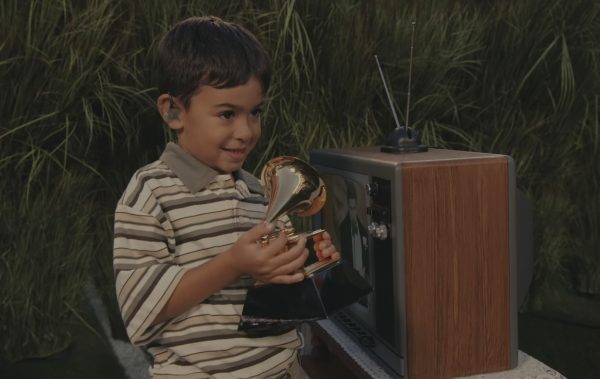
The audience is guided to a child with his parents, watching Bad Bunny’s acceptance and thank you speech at the Grammys, primarily talking about ICE OUT, and speaking for the Latino community. His speech grew in popularity after stating, “We’re not savage, we’re not animals, we’re not aliens, we are humans, and we are Americans”. Bad Bunny hands a Grammy award to the child, though it’s not 100% known what it represents; some think it is Bad Bunny as a child, finally seeing his success. Or could represent the future generations of the Latino community achieving great success and representation, as well as seeing opportunity after seeing Bad Bunny become the first Latino artist to win “Best album of the year award” with an album spoken in almost entirely Spanish.
Bad Bunny climbs onto a sparking electricity pole, with a few women standing on the others, referencing the ever-standing problem of electricity in Puerto Rico. The poles are sparkling and look weak, calling out the actual conditions of Puerto rican electrical infrastructure. As the electricity is weak and extremely unreliable, especially post-Hurricane Maria, there have been frequent power outages in Puerto Rico, with it often being a neglected issue.
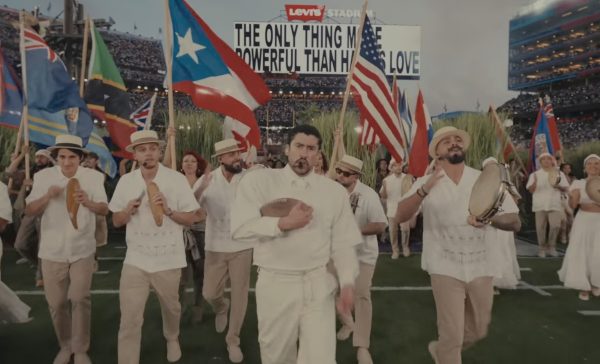
Lastly, he walks back to the field, holding a football and stating, “God bless America”, people with all the American flags follow behind him as he follows shouting out, “Chile, Argentina, Uruguay, Paraguay, Bolivia, Peru Ecuador, Brasil, Colombia, Venezuela, Guyana, Panama, Costa Rica, Nicaragua, Honduras, El Salvador, Guatemala, Mexico, Cuba, Republica Dominicana, Jamaica, Haiti, Canada, The United States, and my motherland, Mi patria, Puerto Rico. Seguimos aqui.” (We continue here/We are still here), he then lifts up the football, with the words on it “Together we are america”
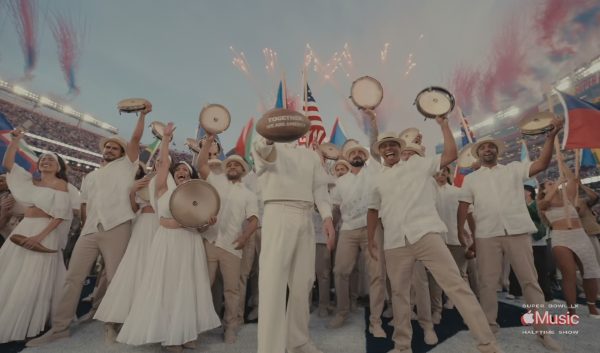
This halftime show was a protest against the recent xenophobia and blatant racism seen in the United States with ICE raids and crackdowns on Hispanic communities. The show reminded us that together we are stronger, and that America is not just the United States, but every other country inside America, predominantly Latin/Hispanic, that make up the Americas. Every community deserves representation, and Bad Bunny did just that with the many easter eggs in his halftime performance.
Sources:
https://www.wlvt.org/blogs/lehigh/ley-de-la-mordaza-the-law-that-made-the-puerto-rican-flag-illegal/#:~:text=While%20the%20Gag%20Law%20was,be%20found%20everywhere%20you%20turn.
https://www.billboard.com/lists/bad-bunny-super-bowl-halftime-show-references-easter-eggs/#:~:text=Gold%20&%20Silver%20Bad%20Bunny%20passes%20by,a%20man%20who%20proposes%20to%20a%20woman.
https://www.ers.usda.gov/sites/default/files/images/rise-and-decline-of-puertorico_5_17.pdf
https://www.usace.army.mil/About/History/Historical-Vignettes/Relief-and-Recovery/154-Hurricane-Maria/
https://www.weather.gov/sju/maria2017
https://www.yahoo.com/entertainment/music/articles/hidden-details-bad-bunny-super-160544181.html#:~:text=The%20electrical%20pole%20wasn’t,Top%20Artist%20for%202025%20Wrapped
https://ca.rollingstone.com/all-of-the-hidden-symbols-and-meanings-you-may-have-missed-in-bad-bunnys-super-bowl-set/#:~:text=As%20Bad%20Bunny%20walked%20through,Latino%20unity%20during%20the%20show.
https://icaa.mfah.org/s/en/item/842571#?c=&m=&s=&cv=&xywh=-1116%2C0%2C3930%2C2199
https://www.latimes.com/archives/la-xpm-2009-may-30-et-nuyorican30-story.html
Love bad bunny referencing kids falling asleep on two chairs at black and brown family events 😭😭
byu/molly_ringworm_ inBadBunnyPR
Bad Bunny's Super Bowl Halftime Show Performance
byu/handlit33 inFauxmoi